
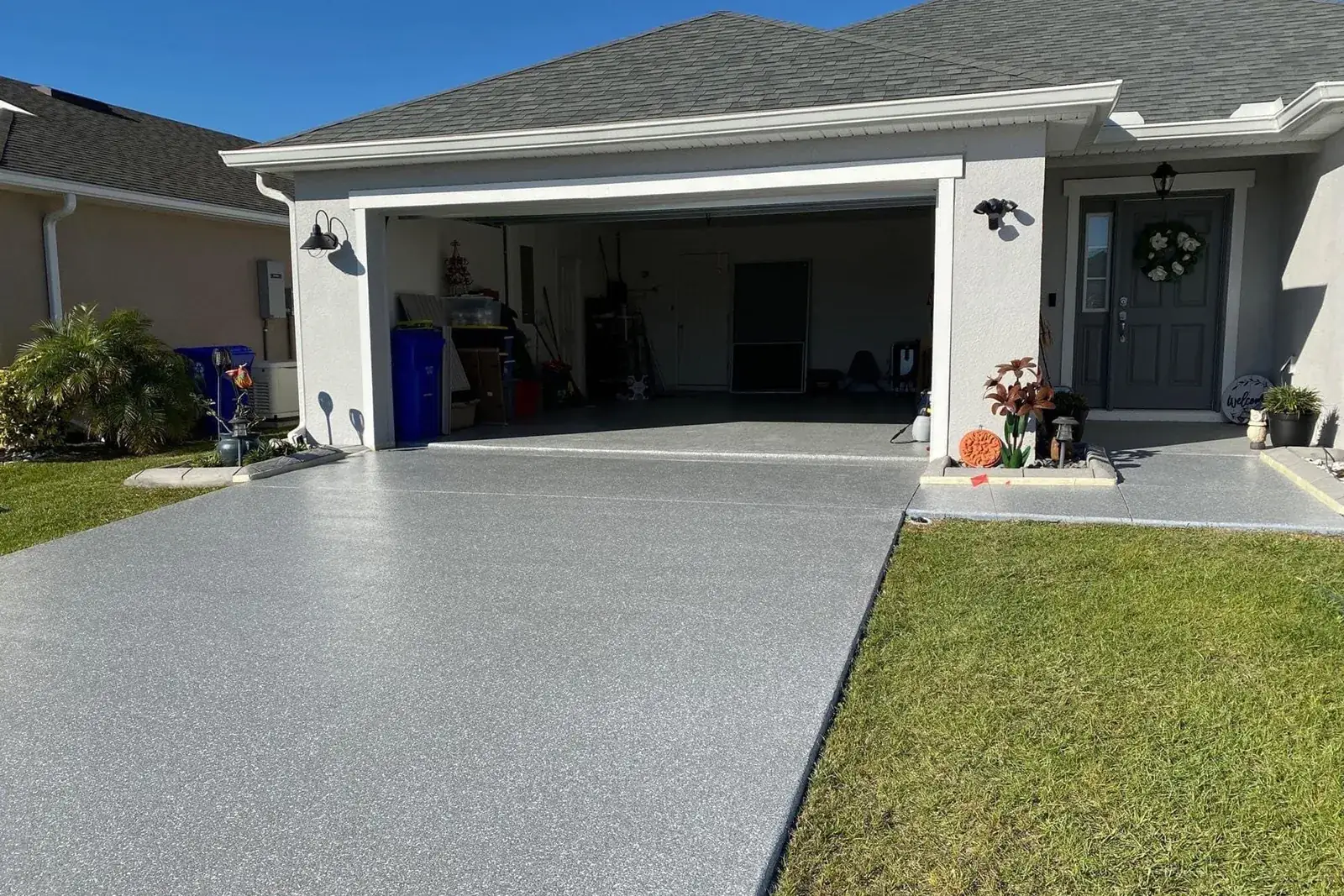
Driveway coating options in Florida: which one is best for your concrete?
On a sound driveway, a flake system under a UV stable polyaspartic topcoat has the longest published lifespan of the coatings on this list. A penetrating sealer is enough if you like bare concrete and will reseal it on a schedule. Overlays and pavers make sense when you want a whole new surface over the old slab.
We coat driveways and walkways across Pinellas, Hillsborough and Pasco counties and the city of Sarasota. Our driveway and walkway coatings are the flake and polyaspartic option on this list. Figures for the other options come from published cost guides, with the publisher named.
What are the driveway coating options in Florida?
HomeGuide notes that you can use concrete coatings on a driveway. For an existing concrete driveway or walkway, here are the main finishes:
- Penetrating sealer. A clear sealer that soaks in and leaves no film on top.
- Film forming sealer. A clear acrylic or urethane layer on the surface.
- Concrete paint. A colored film rolled or sprayed onto the slab.
- Concrete stain. Color that soaks into the top of the concrete, sealed over.
- Plain epoxy. A single resin coat, usually with a smooth finish.
- Flake system with a polyaspartic topcoat. The option we install: a ground and repaired slab, a base coat, full broadcast flake and a UV stable topcoat.
- Overlay or resurfacing. A thin layer of cement and polymer resin over the old slab.
- Pavers over the slab. Brick or concrete pavers set over sound concrete.
What does Florida weather do to a driveway finish?
A Florida driveway sits in full sun all year and takes a summer of afternoon storms. Per the National Weather Service Tampa Bay office, the rainy season runs May 25 to October 10 around Tampa Bay. The NWS describes it as warm and humid, with frequent showers and thunderstorms.
Rain keeps slabs damp and puts water on the surface you walk on. HomeGuide says old concrete must be completely dry before resealing. A coating needs a dry slab too, so we moisture test before we quote.
Sun is the slow test, and plain epoxy is the weak spot. HomeGuide says epoxy coatings are more prone to cracking and UV damage. That is why our outdoor systems finish with a UV stable polyaspartic or urethane topcoat.
Hot tires are the daily test, since a car parks on the same spot off a hot road. A thin or soft film can lift under the tires, a failure called hot tire pickup. Ground concrete and a hard topcoat resist it; see why epoxy floors peel in Florida.
Grip is the last test. Smooth films can turn slick in an afternoon storm. HomeGuide lists non slip textured sealers as a way to prevent falls. On a coating, topcoat texture does that job; see whether a coated floor is slippery when wet.
Is a concrete sealer enough for a driveway?
Often, yes. A sealer is the lowest cost way to protect sound concrete. HomeGuide puts concrete cleaning and sealing at $1 to $3 per square foot. HomeGuide also says sealants use a very thin layer that only protects the floor from water or stains.
A penetrating sealer soaks in and leaves no surface film. HomeGuide lists penetrating sealers with a non slip matte finish, which suits a wet Florida driveway. With no film on top, there is nothing for a hot tire to lift.
A film forming sealer sits on top as a thin clear layer. HomeGuide calls acrylic the thinnest concrete sealant and says acrylic sealers last 1 to 3 years. Epoxy or urethane sealers last 5 to 15 years, per HomeGuide. It also says polyurethane protects colors from fading.
A sealer is enough when the slab is sound and you are happy with the look of bare concrete. Plan on resealing, though. HomeGuide’s paver guide lists a plain concrete driveway as needing yearly power washes and sealing every 1 to 3 years. Concrete sealers won’t fill cracks, HomeGuide notes, so repairs come first either way.
What about concrete paint or concrete stain?
Paint is the low cost way to add color to a slab. HomeGuide puts the cost to paint a garage floor at $2 to $4 per square foot. HomeGuide also says paint only lasts 1 to 5 years compared to other coatings. On a driveway, that thin film sits under hot tires every day.
Stain puts color into the top of the concrete instead of on it. HomeGuide puts staining concrete floors at $3 to $15 per square foot, depending on the design or pattern. HomeGuide calls stain high maintenance, since it requires a sealant every 1 to 3 years. The color stays in the concrete, while the sealer over it wears like any sealer. Both finishes need sound concrete underneath.
Is epoxy good for driveways?
Epoxy works on a driveway as a base coat. As the only coat in full sun, it is the weak spot. HomeGuide puts epoxy floor coatings at $4 to $10 per square foot installed. HomeGuide lists epoxy at 3 to 20 years and says it takes up to 1 week to cure.
The type of epoxy matters as well. HomeGuide says water-based epoxy is far less durable than solvent or solid epoxy coatings. It also says epoxy is not as strong as polyurea or polyaspartic coatings.
So can you epoxy a driveway? Yes, as part of a system. Most of our installs are hybrids: an epoxy or polyurea base coat under a polyaspartic wear coat. Our post on epoxy vs polyaspartic in Florida goes deeper on why the topcoat matters outdoors.
What does a flake system with a polyaspartic topcoat do differently?
This is the option our crew installs on driveways and walkways. We diamond grind the slab, fix cracks and spalls, then moisture test it before we quote. A base coat goes down, and our full broadcast flake system goes into it while it is wet. A UV stable polyaspartic topcoat locks the surface.
HomeGuide puts polyaspartic floor coatings at $5 to $12 per square foot installed. HomeGuide lists polyaspartic at 10 to 20 or more years, with 1 to 2 days to cure. It also says coatings are thicker than sealers and can tolerate more foot traffic.
We tune the anti slip texture in the topcoat for wet areas. That matters, because HomeGuide’s sealer chart flags a glossy polyaspartic sealer as slippery when wet.
Our site photos include one of our Pinellas County jobs: a flake coating on a condo community walkway. A coating needs sound concrete. A slab that is settling or heaving needs concrete work first, and we say so at the quote. You also give up the driveway while it cures, and the quote gives you that timeline.
When does an overlay or resurfacing make sense?
An overlay suits a slab that is sound underneath but rough or flaking on top. HomeGuide puts concrete driveway resurfacing at $3 to $5 per square foot. A decorative or stamped overlay costs $6 to $20 per square foot, per HomeGuide.
HomeGuide says concrete resurfacing lasts 8 to 15 years before needing any repairs. It also says most overlays last as long as the concrete base underneath them. Large cracks in the old slab will quickly transfer up through the new surface, HomeGuide warns.
HomeGuide lists a sealer as the finish over an overlay, to protect the new surface and preserve its appearance. HomeGuide also notes an overlay may become slippery when wet.
Are pavers over the old slab a better choice?
Pavers trade the slab’s surface for separate units with joints between them. HomeGuide says brick pavers can be installed over existing concrete or asphalt if it is in good shape. Repairing cracks, chips or holes comes first, to give a flat surface, HomeGuide adds.
HomeGuide puts driveway pavers at $10 to $30 per square foot installed, a figure for a full paver driveway. HomeGuide says a paver driveway lasts 25 to 75 years, the longest figure on this list. Its comparison table rates pavers as not as slippery when wet, depending on material.
Pavers bring their own upkeep. HomeGuide puts the cost to seal pavers at $1.50 to $3.25 per square foot. It also says pavers can sink or crack if installed over a poorly graded surface. Setting pavers on top of the slab raises the driveway, which matters at the garage door and the street edge.
How do the driveway coating options compare side by side?
The table puts each option against what a Florida driveway tests. Lifespans and costs are HomeGuide’s published figures. The coating row assumes a ground, repaired slab under a UV stable topcoat.
| Option | Sun and heat | Grip when wet | Published lifespan (HomeGuide) | Published cost per square foot (HomeGuide) |
|---|---|---|---|---|
| Penetrating sealer | Concrete keeps its own look | Non slip matte finish | Plain concrete: reseal every 1 to 3 years | $1 to $3 for sealing |
| Film forming sealer | Urethane protects colors from fading | Smooth; textured sealers add grip | Acrylic 1 to 3 years, epoxy or urethane 5 to 15 years | $1 to $3 for sealing |
| Concrete paint | Thin color film in full sun | Smooth unless grit is added | 1 to 5 years | $2 to $4 (garage floor figure) |
| Concrete stain | Color stays; the sealer on top wears | Same as the sealer on top | Sealant every 1 to 3 years | $3 to $15 |
| Plain epoxy | More prone to cracking and UV damage | Smooth unless texture is added | 3 to 20 years | $4 to $10 installed |
| Flake system with polyaspartic topcoat | UV stable topcoat faces the sun | Anti slip texture tuned for wet areas | 10 to 20 or more years (polyaspartic) | $5 to $12 installed (polyaspartic) |
| Overlay or resurfacing | Sealed like bare concrete | May become slippery when wet | 8 to 15 years before repairs | $3 to $5 for a driveway |
| Pavers over the slab | Lower heat absorption than concrete | Not as slippery when wet, depending on material | 25 to 75 years | $10 to $30 installed (full paver driveway) |
The figures measure different jobs, so read them as rough bands. For the per square foot detail on coatings, see what a driveway coating costs in Florida. A real number for your driveway needs an on-site look.
Which is the best driveway coating for your slab?
Pick a penetrating sealer if the slab is sound and you like bare concrete. Pick a flake system with a polyaspartic topcoat if you want color and grip that last on a sound slab. Pick an overlay if the surface is worn but the base is solid. Pick pavers if you want separate units and the budget allows.
HomeGuide says coatings are worth it for many homeowners because they are more durable than staining, painting, or sealing. You pay more up front and recoat less often. On a driveway that takes sun and summer storms, that trade is worth pricing out. If the garage is next on your list, our garage floor epoxy service uses the same prep.
From a Google review of our work: “Great company! Had my family’s patio done. Fast, detailed and affordable!”
Call (727) 423-5985 for a free on-site quote on your driveway or walkway. We cover Pinellas, Hillsborough and Pasco counties and the city of Sarasota. We test the slab and tell you whether it is a coating candidate. The quote lists the coats and gives you the cure timeline.