
Epoxy vs tile flooring: which is better inside a Florida slab home?
For a Florida slab home, both are hard floors that handle water well. Tile gives a classic look, with grout lines to keep clean. An epoxy floor bonds to the slab as one seamless surface, and published guides price it below installed tile.
We are a Pinellas County crew, and our interior epoxy floors go down on bare concrete slabs. We work across Pinellas, Hillsborough and Pasco counties plus the city of Sarasota. We coat concrete, so every tile and terrazzo figure below comes from a named publisher.
This guide covers the floors inside the house. Garage interlocking tiles are a different product, compared in garage floor tiles vs epoxy.
Which floors are we comparing?
All four floors in this guide go over a concrete slab. Porcelain and ceramic tile get set in mortar, with grout between the pieces. Luxury vinyl plank (LVP) is a vinyl floor made to look like wood. Its planks click together and float over the slab, or glue down to it.
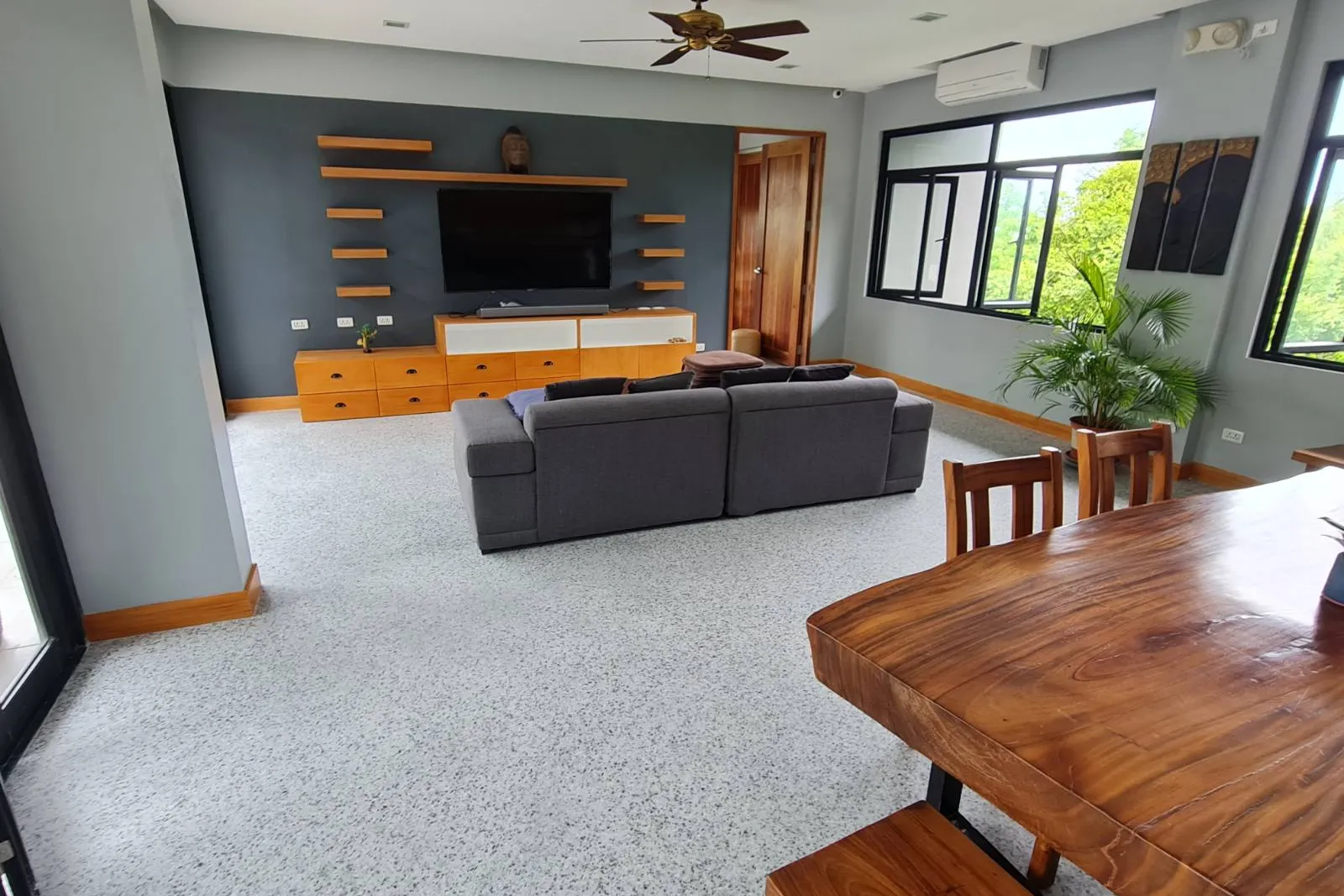
Terrazzo is the classic old Florida floor. In older homes it is mostly marble chips set in Portland cement, polished to a shine. Florida’s mid-century modern homes almost all had terrazzo floors, and most of those floors have since been covered. Homeowners now tear up wood, vinyl, tile and carpet to get back to it.
An interior epoxy floor is built on the slab in layers. We diamond grind the concrete and repair cracks and spalls. We moisture test the slab before we quote. Most of our installs are hybrid systems: an epoxy or polyurea base coat under a polyaspartic wear coat.
Inside the house, the finish can be a solid color or a full broadcast flake floor. A metallic epoxy finish is the decorative option, with a marbled look. The quote lists the coats, so you can see what goes down.
What does each floor cost to install?
Published installed prices put tile at the top of this group and epoxy at the bottom. Homewyse’s May 2026 national average for an installed tile floor starts at $16.38 to $20.21 per square foot. Bob Vila puts epoxy flooring at $3 to $12 per square foot, including installation.
| Floor | Published installed cost per square foot | Publisher |
|---|---|---|
| Tile floor | $16.38 to $20.21 | Homewyse, May 2026 national average |
| Terrazzo tile, glued down | $13.84 to $17.18 | Homewyse, May 2026 national average |
| Epoxy flooring | $3 to $12 | Bob Vila |
Homewyse prices terrazzo tile glued down. The poured terrazzo in older Florida homes is a different floor with its own costs. For LVP, compare installed quotes that spell out the slab prep.
These are published market ranges. Slab condition and old flooring removal move the number for any floor. A real price for your floor needs an on-site look.
How does slab moisture affect each floor?
Most Florida homes sit on a concrete slab poured on the ground. Moisture in the soil moves up through that slab as vapor. Every floor in this guide has to live with it.
Wagner Meters says the calcium chloride test reports pounds of water per 1,000 square feet over 24 hours. Wagner Meters adds that many flooring manufacturers specify an MVER at or below 3 lbs before installation. MVER is the moisture vapor emission rate. Those specs come from flooring makers in general, so ask any installer whether they test the slab.
A coating bonds directly to the concrete, so vapor pushing up meets it from below. Over a slab that gives off too much vapor, a coating can blister and lift. That is why we moisture test before we quote. Other causes are covered in why epoxy floors peel in Florida.
Tile and LVP carry their own moisture rules, set by each product’s maker. A floating LVP floor sits loose over the slab, so ask how it handles vapor from below.
Which floors hold up best in a flood?
FEMA rates flooring for flood zones in its Technical Bulletin 2, updated in January 2025. To FEMA, a flood damage-resistant material can sit in floodwater at least 72 hours and need only cosmetic repair. Cleaning and sanitizing count as cosmetic repair in FEMA’s definition.
The rules cover building materials below the base flood elevation in the zones FEMA calls Special Flood Hazard Areas. The ratings still help any Florida homeowner choosing a floor that might take water. In FEMA’s table of finish materials, the floors in this guide rate like this:
- Epoxy: formed-in-place epoxy flooring is acceptable.
- Terrazzo: acceptable.
- Ceramic and porcelain tile: acceptable when set in mortar, unacceptable when laid with organic adhesives.
- Vinyl: homogeneous vinyl sheets or tiles pass with chemical-set adhesives. All other homogeneous vinyl applications fail, and so does vinyl on cork or wood backings.
- Carpet: unacceptable.
FEMA’s table has no row for luxury vinyl plank by name. FEMA does give an example of why install details matter. Vinyl tile with chemical-set adhesive passes on a concrete floor but fails over plywood.
If flooding is a real risk for your home, ask how the LVP gets installed. Ask whether its maker rates it for floods, too.
FEMA also warns that combinations of materials that trap water or restrict air circulation can lead to unacceptable performance. A bonded coating leaves nothing between the floor and the slab to hold water. FEMA adds that a listing is not a precise indication of how a material will perform in a real flood.
Which is easier to clean: grout lines or a seamless floor?
Grout is the upkeep item with tile. The joints sit just below the tile face, so dirt and mop water settle into them. Over time, grout lines darken and need scrubbing.
LVP has a seam at every plank edge, though its face mops clean. Polished terrazzo has few joints, and it needs proper care after polishing to keep its shine.
An epoxy floor has no grout lines or plank seams. Spills wipe up off the surface, and you can wet-mop the whole floor at once.
Any smooth hard floor can turn slick when wet, glazed tile included. We tune the anti-slip texture for wet areas, and broadcast flake adds grip of its own. More on grip is in whether epoxy is slippery when wet.
How do these floors feel underfoot?
Tile, terrazzo and an epoxy floor all feel as hard as the concrete under them. None of them has any give. LVP has a little more give and feels warmer to bare feet.
Area rugs soften any hard floor, and a cushioned mat helps where you stand to cook. FEMA’s flood guidance even suggests swapping carpet for flood-resistant floors and using throw rugs.
What happens when the slab under the floor cracks?
Slab age matters here. Pinellas County’s median home was built in 1977, per the Census Bureau’s 2024 American Community Survey 5-year estimates. Slabs that old often carry hairline cracks and old patches.
Bonded floors move with the slab. A crack that keeps moving can split tile and grout above it, or come back through a coating. Old terrazzo cracks along with its slab, and filling chips and cracks is part of terrazzo restoration.
A floating LVP floor is not bonded, so a hairline crack stays hidden below it. A crack that lifts one side of the slab can still show through the planks.
For an epoxy floor, we repair cracks and spalls as part of the prep. A crack that is still moving is a slab problem first, whatever goes on top. Coating over a cracked slab covers which cracks coat fine.
How long does each floor last, and how is it repaired?
Bob Vila says epoxy flooring typically lasts between 10 and 20 years. Tile and terrazzo are long lived when the slab under them stays sound. LVP life varies by product line, so ask the seller how long the plank is rated to last.
Repairs differ more than lifespans do. A cracked tile has to be cut out and replaced, and old tile can be hard to match. Damaged LVP planks can be swapped out. Terrazzo gets restored by polishing, a separate trade from coating.
A worn but sound epoxy floor can take a fresh topcoat after surface prep. For the ranges by system, see how long epoxy floors last in Florida.
How do epoxy, tile, LVP and terrazzo compare side by side?
Each column assumes a correct install over a sound slab. Every cost cell names its publisher.
| Criterion | Porcelain or ceramic tile | LVP | Terrazzo | Epoxy floor |
|---|---|---|---|---|
| Published installed cost | $16.38 to $20.21 per square foot for a tile floor (Homewyse) | Compare installed quotes | $13.84 to $17.18 per square foot for glued terrazzo tile (Homewyse) | $3 to $12 per square foot (Bob Vila) |
| FEMA flood rating | Acceptable set in mortar, unacceptable with organic adhesives | Not named; homogeneous vinyl passes only with chemical-set adhesives | Acceptable | Acceptable as formed-in-place epoxy flooring |
| Seams | Grout line at every tile | Seam at every plank | Few joints | Seamless |
| Cleaning | Mop, plus grout scrubbing | Mop | Proper care after polishing | Wet-mop the whole floor |
| Feel underfoot | Hard and cool | Some give, warmer | Hard and cool | Hard and cool |
| Slab cracks | A moving crack can split tile and grout | Hides hairline cracks | Cracks with the slab; chips and cracks get filled | Cracks and spalls repaired in prep |
| Lifespan | Long lived on a sound slab | Varies by product | Long lived; mid-century floors are still being restored | 10 to 20 years (Bob Vila) |
| Repair | Cut out and match tiles | Swap planks | Restored by polishing | Fresh topcoat after surface prep |
Which floor should you pick for a Florida slab home?
Pick tile if you love its look and the slab is sound. Set it in mortar if flood risk is on your mind, since FEMA rates mortar-set tile acceptable. Pick LVP if you want a softer, warmer floor, and ask how it gets installed.
If you have terrazzo in good shape, restoring it keeps a floor FEMA rates acceptable. Pick an epoxy floor for a seamless surface that wipes clean and costs less in published guides. Which rooms suit epoxy is its own question, covered in epoxy floors inside a Florida home.
If a coating fits, the prep is what you are buying. We diamond grind the slab to open the concrete, and we repair cracks and spalls. We moisture test before we quote, and the quote lists the coats. You get the cure timeline at the quote, so you can plan around the room.
A Google review of our work reads: “Great company! Had my family’s patio done. Fast, detailed and affordable!”
Want a real number for your floor? We give free on-site quotes across Pinellas, Hillsborough and Pasco counties and the city of Sarasota. Call (727) 423-5985, and we will look at the slab and price the system it needs.