
Polished concrete vs epoxy: which is better for a Florida garage floor?
For most Florida garages, an epoxy or flake coating system is the better fit. It covers small cracks and holds up to oil drips and wet tires. Polished concrete suits a sound slab where you want bare concrete and can live with re-polishing over time.
We are a Pinellas County crew. Our garage floor epoxy systems start with diamond grinding and crack repair. We moisture test every slab before we quote.
We work across Pinellas, Hillsborough and Pasco counties plus the city of Sarasota. Mechanical polishing is its own multi-step process. Our garage work is grind and seal or a coating system, so polishing figures below come from named publishers.
What are the three garage floor finishes?
Polished concrete is the bare slab, refined in stages. Crews grind with finer and finer diamonds, then harden the surface with a densifier. HomeGuide says true polished concrete doesn’t require sealing, because the densification process hardens the surface.
Grind and seal gives you the polished look without polishing. Our grind and seal concrete floors start with a diamond grind, then a clear sealer goes on top. The concrete stays visible, and the sealer does the protecting.
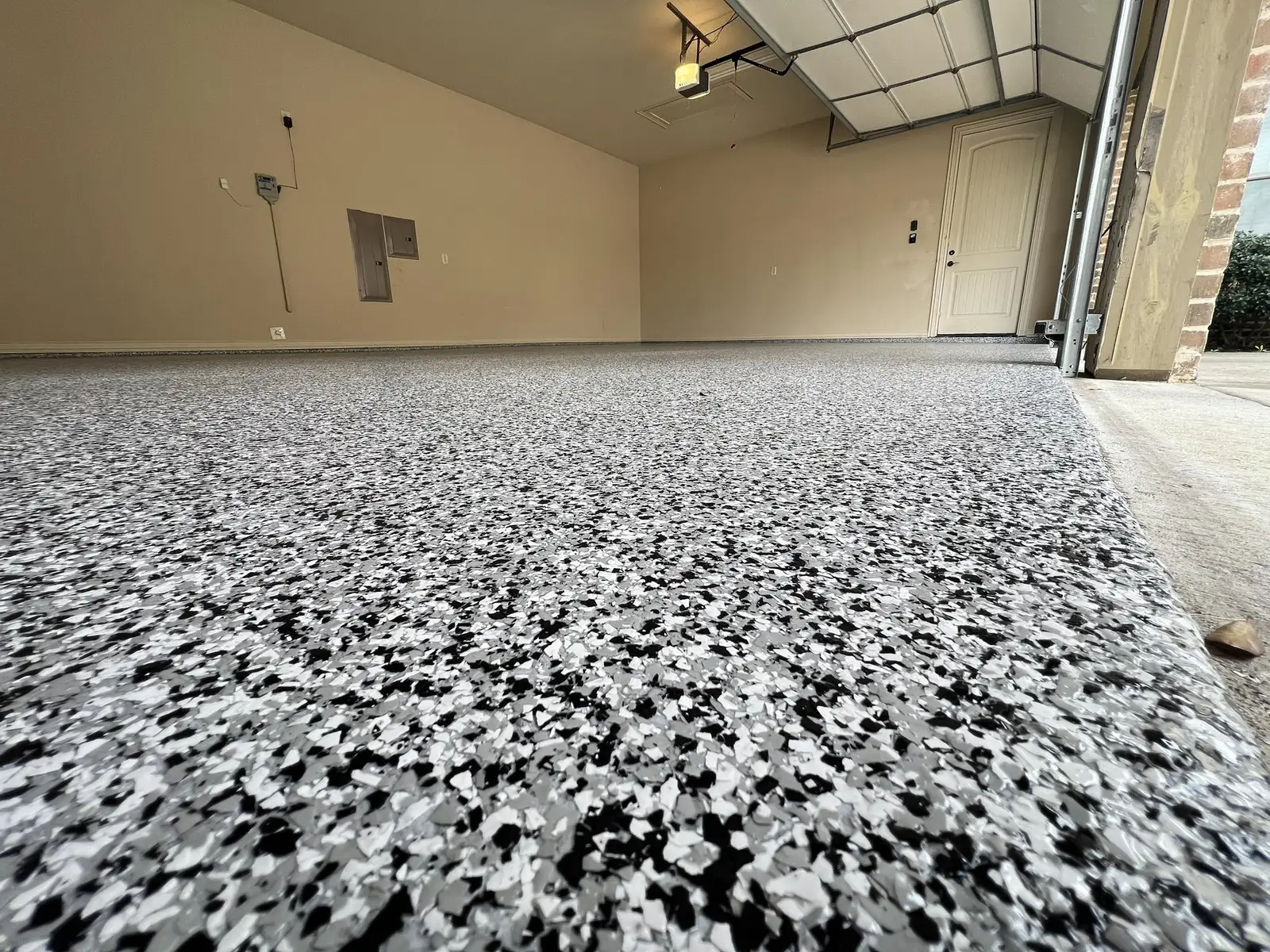
Coating systems are our main garage work. Most of our installs are hybrids, with an epoxy or polyurea base coat under a polyaspartic wear coat. A full-broadcast flake floor is the most popular garage finish we put down. Our polyaspartic floor coating is the wear layer that meets the tires.
What does each finish cost for a garage?
Polished concrete prices climb on small floors, and a garage is a small floor. HomeGuide prices a polished cream finish at $3 to $8 per square foot. HomeGuide puts the mid-level salt and pepper finish at $4 to $10 per square foot. HomeGuide adds that projects under 1,000 square feet often carry premium pricing of $8 to $15 or more.
Bob Vila prices installed epoxy flooring at $3 to $12 per square foot. For a 360 square foot 2 car garage, Bob Vila puts epoxy at about $1,100 to $4,300. At HomeGuide’s small-job rate, polishing that same garage comes to about $2,880 to $5,400 or more. Bob Vila says each extra level of polish adds $0.35 to $0.75 per square foot.
Bob Vila lists basic sealed concrete as an add-on of $0.85 to $1.60 per square foot, its most affordable finish. Our grind and seal cost guide covers sealer prices for larger commercial floors.
| Garage finish | Published cost | Publisher |
|---|---|---|
| Polished concrete, cream finish | $3 to $8 per square foot | HomeGuide |
| Polished concrete, salt and pepper finish | $4 to $10 per square foot | HomeGuide |
| Polished concrete, projects under 1,000 square feet | $8 to $15+ per square foot | HomeGuide |
| Each extra level of polish | adds $0.35 to $0.75 per square foot | Bob Vila |
| Basic sealed concrete finish | adds $0.85 to $1.60 per square foot | Bob Vila |
| Epoxy flooring, installed | $3 to $12 per square foot | Bob Vila |
| Epoxy in a 360 square foot 2 car garage | about $1,100 to $4,300 | Bob Vila |
For the coating side in more detail, read what an epoxy garage floor costs in Florida. Every slab prices differently, so a real number needs an on-site look.
How do hot tires treat each garage floor?
Polished concrete has no film on top, so there is nothing for a hot tire to lift. Prosoco, a concrete sealer maker, says a silicate densifier becomes part of the concrete and doesn’t peel.
A grind and seal floor is only as tough as its sealer. Prosoco says water-based acrylic sealers may have less resistance to tire marking or chemical staining. On a garage, we use a clear urethane or polyaspartic sealer.
Coatings face hot tire pickup, where a thin film lifts in patches under hot tires. It shows up on thin films and on slabs that were never ground. A ground slab under a polyaspartic wear coat is how we build a garage for parked cars.
What happens when oil and fluids drip on each floor?
Cars drip oil and coolant, so stain resistance matters in a garage. HomeGuide lists polished concrete as not completely stain proof, and says chemical or acid spills can damage it. HomeGuide adds that a stain-guard sealer helps prevent staining in garages. Bob Vila says polished floors are not typically sealed, and use penetrating liquids to prevent spots and scuff marks.
On grind and seal, the sealer takes every drip, which is why Prosoco’s acrylic warning matters in a garage. A coating keeps fluids on the surface. Bob Vila says epoxy flooring will withstand spills, leaks, and drips without staining. Prosoco says cured epoxy resists oil, solvents, acids, and physical impact.
Which garage floor gets slippery when wet?
Water is the Florida garage problem. The National Weather Service Tampa Bay office dates the rainy season from May 25 to October 10. Those dates apply to most of West Central Florida. Cars roll in wet, and rain blows under the door.
HomeGuide says polished concrete becomes slippery when wet, similar to tile or hardwood. Bob Vila says polished floors can be up to 50 percent more slip-resistant than the national low-slip standard. Even so, Bob Vila suggests an anti-slip coating on a polished patio, to keep it from getting slippery during rainstorms.
A grind and seal floor carries the same risk in its sealer. Prosoco says glossy coatings become slick when wet unless textured properly. We add a grip additive to the sealer wherever a floor gets wet.
Coatings answer the problem with texture. Prosoco says high-gloss epoxies can become dangerously slick when wet unless grit or texture goes into the topcoat. A full-broadcast flake floor adds texture by itself, and we tune the anti-slip texture for wet areas. Our guide to how grip gets built into a coating covers grip levels room by room.
How does Florida slab moisture affect each finish?
Garage slabs sit on the ground, so vapor rises through them. Prosoco says slab-on-grade assemblies often require breathable systems, to prevent vapor pressure from building beneath the coating. Polished concrete has the easiest time here. Prosoco’s sealer table lists silicate densifiers as breathable and suited to densified or polished slabs.
Grind and seal depends on the sealer you pick. A sealer over a damp slab can cloud or peel. We test the concrete first and match the sealer to the reading.
Coatings carry the most moisture risk. Prosoco says epoxy coatings trap moisture and can peel or blister if applied to damp concrete. We moisture test before the quote for exactly that reason.
Which finish handles cracks and an older slab?
The median home in Pinellas County was built in 1977, per Census Bureau 2024 survey data. The same Census Bureau data puts the Hillsborough County median at 1991. Slabs that age often carry cracks and a coat of old paint or sealer.
Polishing works the bare slab, so there is no coating on top to hide a patch. HomeGuide notes polished concrete can chip and hairline crack over time. Bob Vila says holes or cracks need repair before a new polished concrete floor goes in. HomeGuide adds that old sealers or epoxy coatings must be stripped before polishing.
Grind and seal shows the slab too. The grind takes off old coatings and surface stains. Patches and old repairs stay visible under the clear sealer.
A coating covers what it repairs. Bob Vila says chips and cracks need repair before the epoxy goes down. Bob Vila adds that epoxy can hide flaws in the concrete or small cracks. When a crack runs deeper than a patch, read about epoxy over cracked concrete.
How long does each finish last, and what upkeep does it need?
HomeGuide says polished concrete can last a lifetime with minimal maintenance. The shine is the part that wears. Bob Vila says most concrete floors need to be polished every 2 to 3 years.
Grind and seal works the same way. The slab lasts, and the sealer is the wear layer. Prosoco says water-based acrylic sealers often require reapplication sooner. A worn sealer gets recoated instead of rebuilt.
Bob Vila says an epoxy floor typically lasts 10 to 20 years when it is properly maintained. Upkeep is a sweep and a damp mop.
How do the three finishes look?
Polished concrete stays gray. Bob Vila says different levels of shine come from different grit numbers.
Grind and seal looks much the same. A light grind keeps the concrete smooth and gray, and a deeper grind exposes sand and aggregate. The sealer sets the sheen, from matte to gloss.
Coatings change the color of the floor. Bob Vila says epoxy comes in a variety of colors and blends of decorative flakes, and in metallic hues. Flake is our most popular garage look, and metallic or solid color are the alternatives.
How do polished concrete, grind and seal and epoxy compare side by side?
Here is how the three finishes stack up in a Florida garage. Each cell reflects a named publisher or the way we build our own systems.
| Factor | Polished concrete | Grind and seal | Epoxy or flake system |
|---|---|---|---|
| How it is made | Finer and finer diamond passes plus a densifier, no coating on top | Diamond grind, then a clear sealer | Ground and repaired slab, base coat, flake, polyaspartic wear coat |
| Hot tires | No film for a tire to lift | Water-based acrylics may mark more (Prosoco), so a garage gets a tougher sealer | Thin films can lift; a polyaspartic wear coat is built for parked cars |
| Oil and fluid drips | Not completely stain proof (HomeGuide) | The sealer takes the drip | Withstands drips without staining (Bob Vila) |
| Wet tires and slip | Slippery when wet (HomeGuide) | Grip additive in the sealer where it gets wet | Anti-slip additives (Bob Vila) plus flake texture |
| Slab moisture | Densifier stays breathable (Prosoco) | Sealer matched to the moisture reading | Moisture test first; epoxy can blister on damp concrete (Prosoco) |
| Cracks and patches | No coating on top to hide a patch | Patches and repairs show | Repaired, then covered by color or flake |
| Old paint or sealer | Must be stripped first (HomeGuide) | Ground off in prep | Ground off in prep |
| Upkeep | Polished again every 2 to 3 years (Bob Vila) | Sealer recoated as it wears | Sweep and mop, 10 to 20 years (Bob Vila) |
| Look | Gray concrete, sheen set by grit | Gray concrete, matte to gloss | Flake blends, solid colors or metallics |
Which finish should you pick for your garage?
Pick polished concrete if the slab is sound and you want bare concrete with no coating on top. Plan on re-polishing for the shine and on wiping drips up fast.
Pick grind and seal if you like the concrete look at a lower add-on cost. The sealer gets recoated as it wears, and it needs grip where the floor gets wet.
Pick an epoxy or flake system if the car parks inside and drips. It also suits an older slab, since the repairs sit under the coating.
One Google review of our work reads: “Great company! Had my family’s patio done. Fast, detailed and affordable!”
Want a real number for your garage? We give free on-site quotes across Pinellas, Hillsborough and Pasco counties plus the city of Sarasota. Call (727) 423-5985. We test the slab for moisture, and the quote lists the coats and the cure timeline.